Brener
2015
Ceramics, Projects, Sculpture
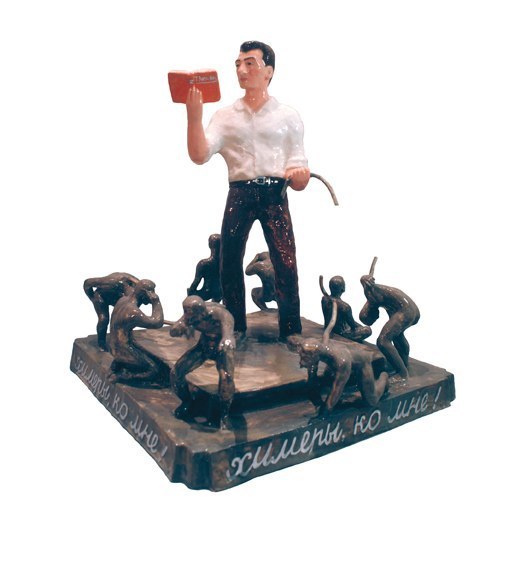
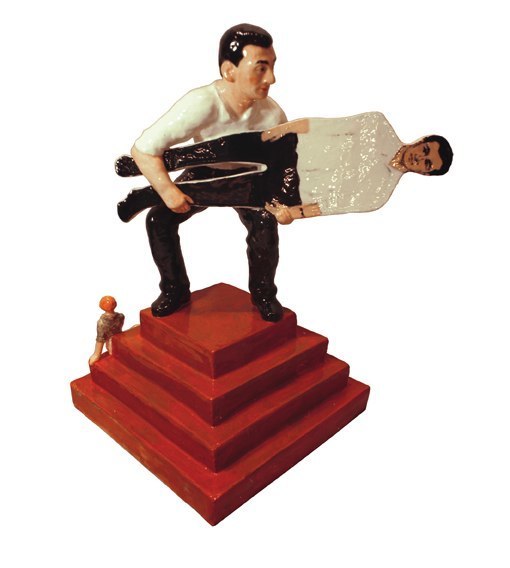
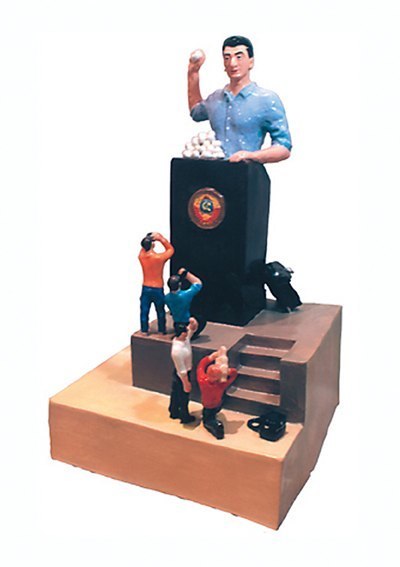
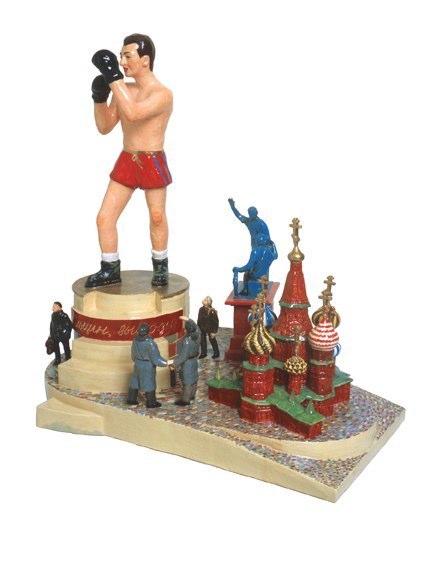
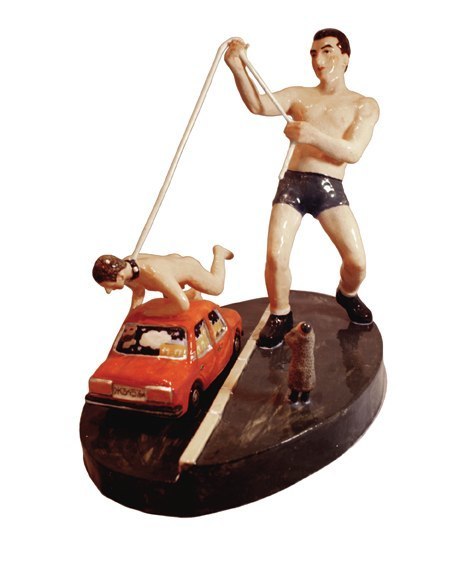
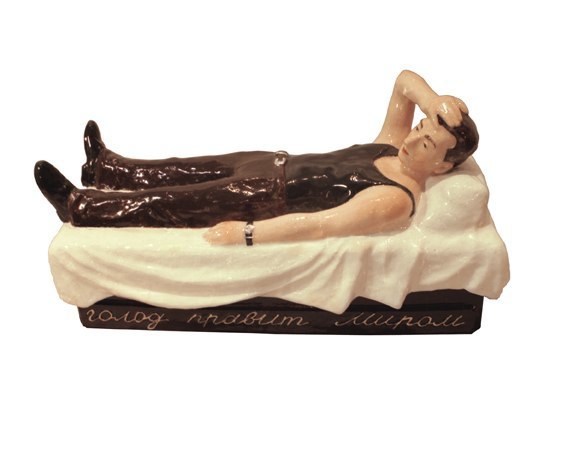
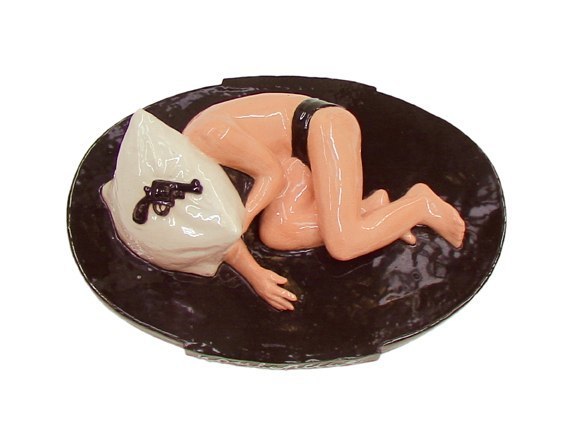
Poet and Speaker as well as Chimeras, Come Here are three works belonging to a larger series in which Tatyana Antoshina realizes a turn unknown to history of art: she “translates” performance art into a porcelain statuary. The main character and the largest figure in each of these small sculptural units is a Russian artist Jewish origin, Alexander Brener, who became known for his radical actions first performed in Russia and later in Western Europe where he currently lives.
In this family of works Antoshina continues to elaborate her major preoccupation: the representation or rather the construction of the maleness in modern and contemporary art. In her previous photographic series, for example, she focused on the most famous artworks showing female nudes — whom she replaced by the male ones. Although many feminist artists have practiced similar “allegorical procedures” since the early 1980s, Antoshina’s interest in the male body, it seems to me, is not so much motivated by her desire to re-write art history but it is more inspired by everyday reality surrounding her. Two aspects of post-perestroika societal context appear to be relevant here. First, the fact that social and political life of post-Soviet age in Russia (as elsewhere in the post-Communist world) is shaped after a model called “democracy with the male face.” And second, even though there were several Russian women artists who became known both locally and internationally during the 1990s, a “female Kabakov” did not come into existence. The truth is that all artistic groups and trends born after the glasnost era have been organized as “boys’ clubs,” with an almost total absence of female members. It seems, hence, that contemporary Russian “art system” continues to cherish the images of the artist as a male genius.
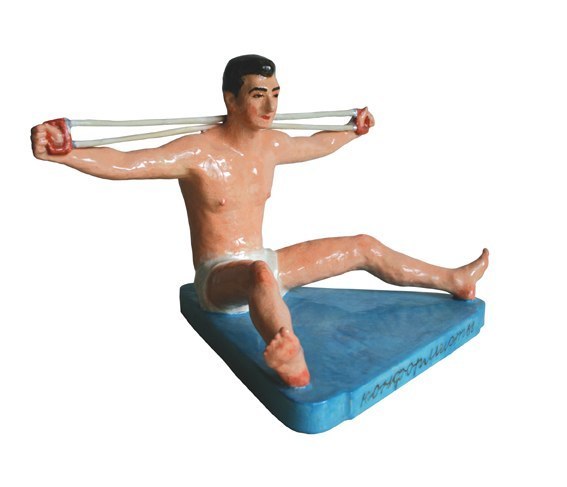
Tatiana Antoshina From Here to Eternity
Poet and Speaker as well as Chimeras, Come Here are three works belonging to a larger series in which Tatyana Antoshina realizes a turn unknown to history of art: she “translates” performance art into a porcelain statuary. The main character and the largest figure in each of these small sculptural units is a Russian artist Jewish origin, Alexander Brener, who became known for his radical actions first performed in Russia and later in Western Europe where he currently lives.
In this family of works Antoshina continues to elaborate her major preoccupation: the representation or rather the construction of the maleness in modern and contemporary art. In her previous photographic series, for example, she focused on the most famous artworks showing female nudes - whom she replaced by the male ones. Although many feminist artists have practiced similar “allegorical procedures” since the early 1980s, Antoshina’s interest in the male body, it seems to me, is not so much motivated by her desire to re-write art history but it is more inspired by everyday reality surrounding her. Two aspects of post-perestroika societal context appear to be relevant here. First, the fact that social and political life of post-Soviet age in Russia (as elsewhere in the post-Communist world) is shaped after a model called “democracy with the male face.” And second, even though there were several Russian women artists who became known both locally and internationally during the 1990s, a “female Kabakov” did not come into existence. The truth is that all artistic groups and trends born after the glasnost era have been organized as “boys’ clubs,” with an almost total absence of female members. It seems, hence, that contemporary Russian “art system” continues to cherish the images of the artist as a male genius.
Antoshina’s choice to “freeze” an ephemeral performance act and convey it to eternity via traditional technique of porcelain is an artistic decision that only appears as a cynical twist common to the art of the late 1990s. These works have, I believe, other and even deeper implications. The “ironic monuments to Brener” (Joseph Backstein) exist on the borderline between the two art traditions, which hardly ever conflated. One is history of High Art, embracing both public sculpture and since recently performance art; the other is history of porcelain, a medium belonging to the applied or “lower” arts.
When we approach the mini-monuments as sculptures, it is clear that Antoshina needed to resolve, with a skill demanded by the small scale, the basic problem every classic sculptor (as well as a photographer) is confronted with: she had to “catch” a movement/moment of the human body and “freeze” it for posterity. This is the famous “pregnant moment” which both Lessing and Cartier-Bresson found as the essence of sculpture and photography, respectively. These works demonstrate the basic nature of performance art as well. It is an art based on the artist’s presence but also an art that can enter history only in a form of documentation. A photographic record is usually taken as ”visible evidence” and a proof that a short-lived event actually took place.
What may appear as Antoshina’s subversive gesture is that performance, having status of High Art, is presented here in the medium of porcelain, usually regarded as “low” since it presumably necessitates craft and skill of an artificer and not a “genius” of the artist. Although porcelain was earlier believed to be a material as precious and valuable as gold, porcelain statuary was often accused for having, in Winckelmann’s words, a “plebeian vitality.” Moreover, it has often been judged as “art of bad taste”, namely, kitsch. In focusing on Brener, Antoshina is well aware that, historically, porcelain statuary was not only manufactured for fun and leisure, but that it was also attributed more responsible tasks. Porcelain manufacturers frequently tended to recount all the Grand Narratives of history, though, in a small scale. Such a “patriotic genre” conquered Europe as well as Russia particularly since the nineteenth century and flourished in the times of wars. It carried nationalistic and pathetic messages and shared so many themes with public statuary.
After 1917, besides patriotism, Russian porcelain manufacturers had to invest their figurines with the ideas of the Great October as well. Even before but in particular over the 1930s, the propaganda porcelain figurines and figural ensembles, like those designed by Natalija Iakowlewa Danko (1892-1942), for example, did their share in the construction of the new homo sovieticus. They pictured Soviet everydayness as a life shared by men and women engaged in making useful deeds.
As she conceived her witty homage to Brener, the “last of the radicals,” Antoshina certainly had this ethical aspect of porcelain making in mind: porcelain statuettes are works-with-a-massage; they usually imply a moral. In these works she does not simply provide a standard female artist’s (or feminist) comment on her male and a more famous colleague. In eternalizing Brener’s provocative and often damaging actions, Antoshina, as it were, questions the role of the (male and Russian) artist in the post-Cold War world. As much as Brenner’s attacks on the “art system” ruled by the capital are destructive in nature, his “retro-anarchism” implies a particular ethic as it is based upon an artistic idealism and a desire to improve the world. Tatyana Antoshina does not expose Brener to mocking, but treats her post-perestroika male hero with mixture of appreciation (even sympathy) and a delicate humor rather then irony. She discretely points out to the common fact that artists of today live in a world in which the radical artistic engagement is either fairly forgotten or considered passé.
Bojana Pejic Berlin, January 2001.
Tatyana Antoshina is one of those Russian women artists who actively explore gender strategies in their art practices. Her characters are engaged in an endless search for gender identity. Antoshina is investigating the aesthetic equivalent of such a search.
One of the central themes of Antoshina's artistic exploration is sexual aggression repressed by social contexts. Her way of reflecting this is an attempt to deconstruct the Male as a cultural code. Her artistic strategy is a visual critique of this code.
One example of such a strategy is her series of ironic monuments to the artist Alexander Brener who is well-known for his radical actions. These are porcelain figurines. A radical male artist is thus diagnosed and "commemorated" by a feminist colleague who finds his narcissistic efforts noteworthy enough to be preserved in the images of urban folklore.
Another characteristic project is The Women's Calendar, which features portraits of real men who happened to have had an influence over the artist. These include her father and schoolteachers, as well as her sex partners.
A similar method is used in The Museum of Women, which exhibits a series of staged photographs based on classical paintings featuring female nude figures. In these Antoshina has substituted female nudes for the male ones highlighting that, in terms of gender, cultural and aesthetic roles are ambivalent.
Antoshina's artwork has a special contextual connotation within the highly contradictory social and cultural condition of Russian women. The USSR proclaimed equal rights for men and women. In the post-USSR period, however, Russia is a society that flaunts male chauvinism.
Joseph Backstein